شركة التقنية
- 31 January
- 0 Comment
- 605 مشاهدة

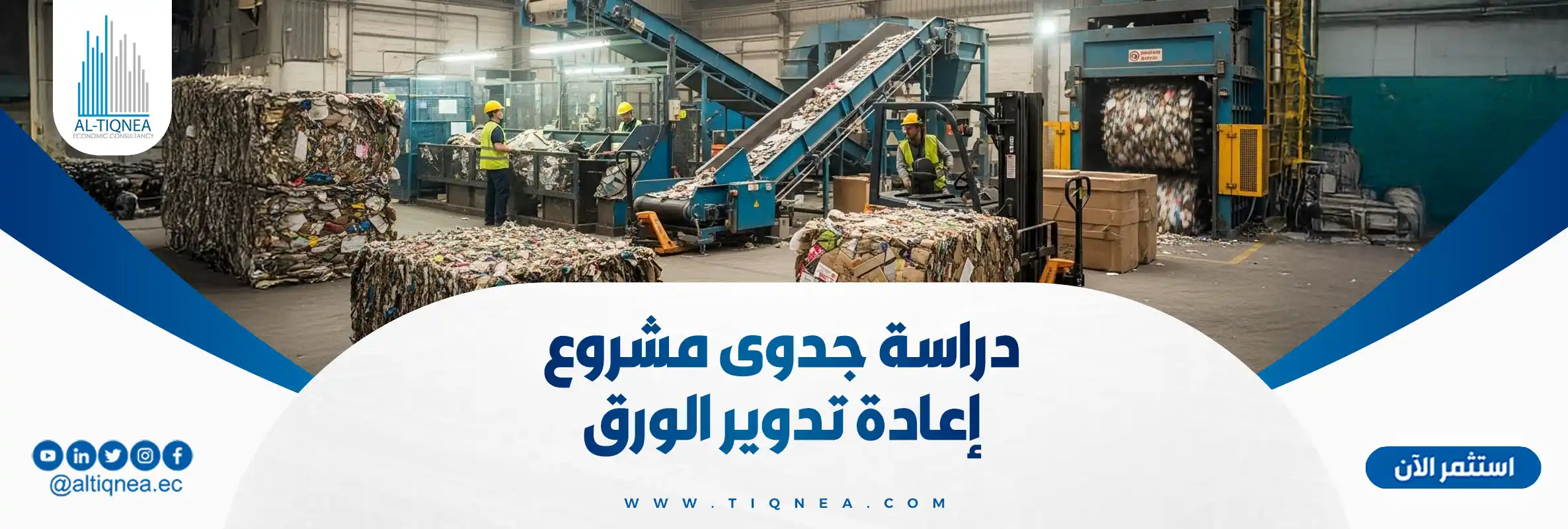
The feasibility study of a paper recycling project represents a fundamental step for any investor seeking an investment opportunity that combines economic returns with environmental sustainability. With the increasing consumption of paper across educational, commercial, and industrial sectors, along with rising costs of virgin raw materials, investing in paper recycling has become one of the most promising projects that meet market needs and support the government’s orientation toward a green economy.
The feasibility study analyzes all technical, financial, and marketing aspects of the project, ensuring a well-informed investment decision based on accurate data and realistic growth opportunities.
The paper recycling project is considered one of the sustainable industrial projects that aim to convert paper waste of various types into new paper products that can be reused, contributing to reducing reliance on virgin raw materials, lowering production costs, and minimizing negative environmental impacts.
The project relies on collecting and sorting paper waste such as printing paper, newspapers, cardboard, and paper waste generated by educational and commercial institutions. These materials are then reprocessed using advanced industrial technologies to produce recycled paper with quality levels that meet local and industrial market requirements.
The project is characterized by flexibility in production capacity and the possibility of future expansion, in addition to the high demand for its products in multiple sectors such as packaging, printing, and food manufacturing. This makes it a promising investment opportunity with stable and sustainable returns.
The project produces a wide range of recycled paper products, including:
Recycled Printing and Writing Paper
Used in schools, offices, and printing houses with medium-quality requirements.
Cardboard and Paperboard
Used in the manufacturing of packaging boxes and shipping cartons.
Tissue Paper and Hygienic Paper (depending on the production line)
Produced after additional processing stages to ensure softness and hygienic quality.
Industrial Paper Rolls
Used in factories and production lines, especially in the packaging sector.
Compressed Paper Boards
Used in certain light industrial and commercial applications.
The feasibility study of a paper recycling project classifies it as one of the most promising industrial projects that combine environmental sustainability with economic feasibility, for several key reasons, including:
Continuous growth in demand for recycled paper products across various sectors, particularly packaging and printing.
Lower raw material costs compared to virgin paper, as the project relies on widely available paper waste.
Government support and environmental policies encouraging recycling projects within sustainable development plans.
Diversification of revenue sources due to multiple end products and access to different markets.
Ease of future expansion by increasing production capacity or adding new production lines.
High added value achieved by transforming waste into marketable products with attractive returns.
The project serves a wide range of vital sectors, reducing the risks associated with dependence on a single customer or market. Key target sectors include:
Packaging Sector
Carton factories, shipping companies, and e-commerce businesses.
Educational Sector
Schools, universities, and publishing houses.
Printing and Publishing Sector
Printing presses, newspapers, and magazines.
Industrial Sector
Factories that use industrial paper or internal packaging materials.
Commercial and Administrative Sector
Companies, banks, and institutions that rely on office paper.
Healthcare and Service Sector
Hospitals, hotels, and restaurants (in the case of hygienic paper production).
The success and sustainability of the feasibility study of a paper recycling project depend on several operational, managerial, and marketing factors, including:
Securing stable sources of paper waste through long-term contracts with suppliers.
Selecting appropriate technology that balances product quality with operating costs.
Efficient management and operation, optimizing production processes and minimizing waste.
Compliance with environmental and health standards to avoid regulatory obstacles.
Market analysis and competitive pricing strategies to achieve sustainable profit margins.
Building a strong customer network within the target sectors.
An effective marketing plan highlighting the environmental and economic value of the products.
The ability to develop and expand in line with market changes and customer needs.
Al-Tiqnea does not only provide feasibility studies, but also delivers integrated investment solutions, including:
Preparing accurate and accredited feasibility studies.
Supplying production lines and required machinery.
Developing implementation plans and transferring project know-how.
Executing projects on a Turnkey Service and delivering them ready for operation.
Providing consulting and managerial services to ensure operational sustainability and profitable returns.
To request a feasibility study for your project or schedule a meeting, Contact Us Now, and one of our experts will get in touch with you as soon as possible.
Comprehensive Feasibility Study for a Carton Factory The carton industry is one
New Incentives for Industrial Projects in Egypt The Ministry of Industry announced
Production Line Financing for Industrial Projects Al-Tiqnea Company announces a new strategic
Discover the Most Promising Industrial Sectors for Investment in the UAE On
إستثمر الآن في 28 فرصة لصناعات واعدة وفقًا لوزارة الصناعة طرحت وزارة
حوافز وفرص استثمارية واعدة في القطاع الصناعي حوافز وفرص استثمارية واعدة في